
By Muttaka Turaki Gujungu
“And if two groups of the believers fight, make peace between them.”
Qur’an 49:9 (Surah Al-Hujurat, Verse 9).
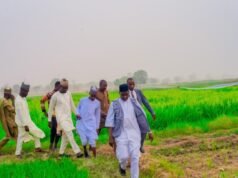
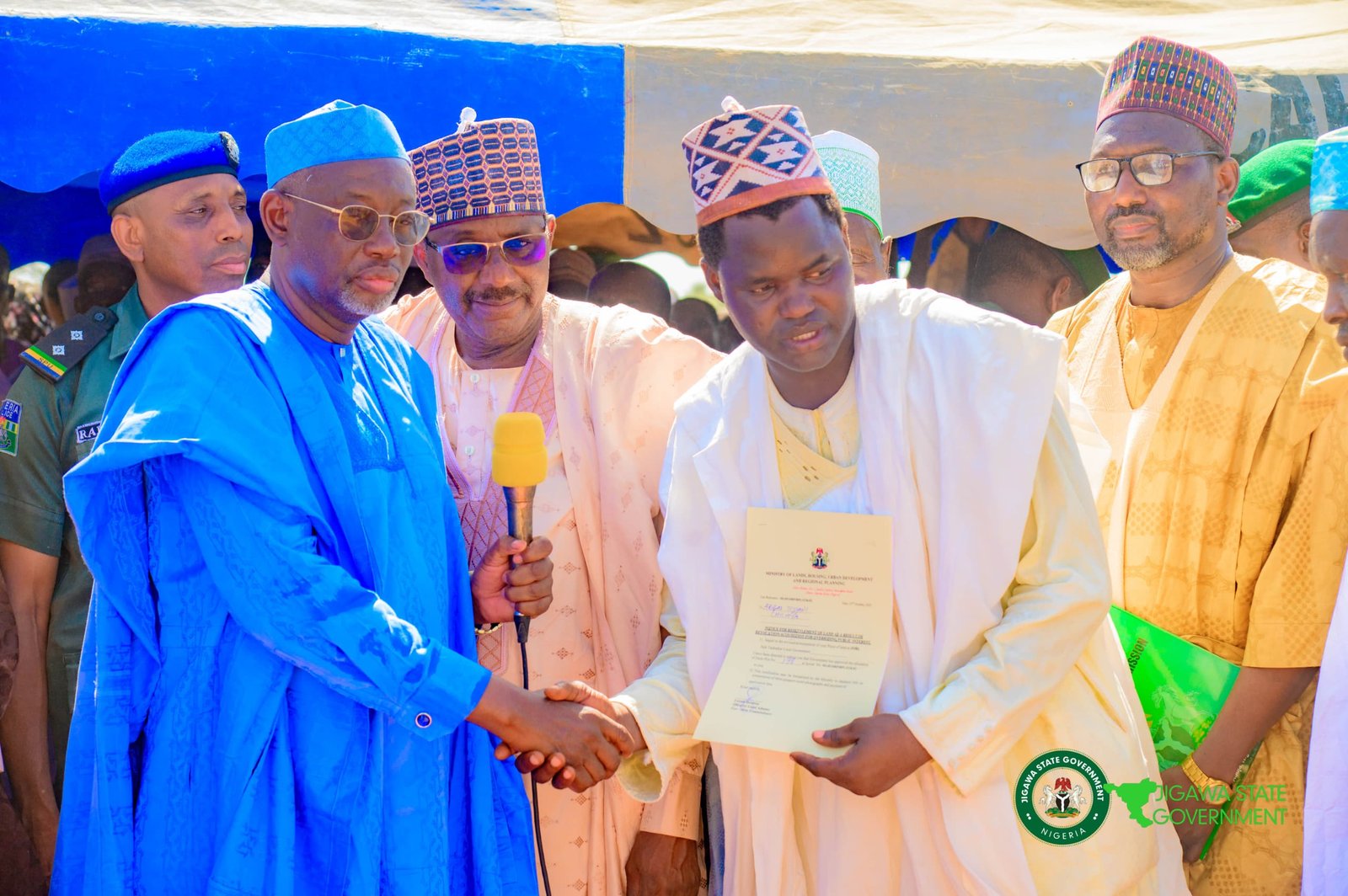
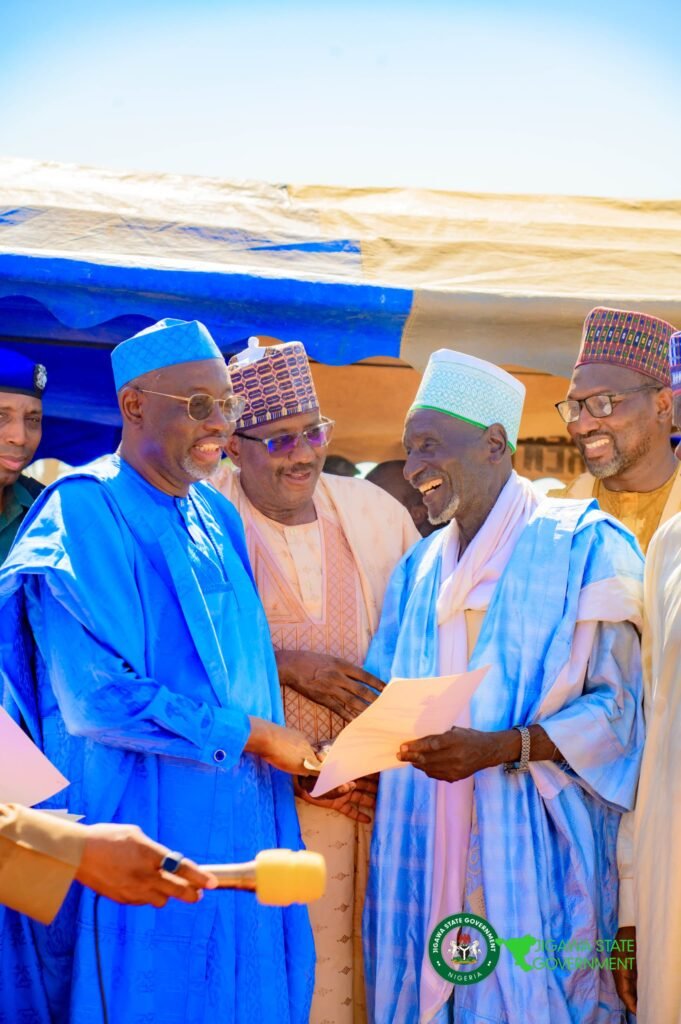
In the quiet expanse of the Dan-Makama Forest Reserve in Jigawa State, a modest gathering on a hot July afternoon unfolded with understated significance. Government officials, traditional rulers, community leaders, security personnel and ordinary farmers assembled not for a lavish commissioning but for a quiet act of restitution. With the simple allocation of alternative farmlands to members of the Jobi community, Governor Malam Umar A. Namadi, FCA, brought to a peaceful close one of northern Nigeria’s most protracted cross-border land disputes — a conflict that had endured for 47 years between Jobi in Maigatari Local Government Area and the neighbouring Kyalli community in the Republic of Niger.
There were no elaborate displays of triumph. Yet for the affected families, this moment represented far more than bureaucratic land reallocation. It marked the restoration of dignity, economic security and hope after nearly five decades of uncertainty, anxiety and occasional confrontation. In a region where access to fertile soil defines survival, the resolution transcended mere administrative success. It demonstrated how patient diplomacy, institutional collaboration and people-centred governance can transform an inherited colonial-era problem into an opportunity for reconciliation and renewed prosperity.
The story of Jobi and Kyalli is emblematic of broader challenges along Nigeria’s northern frontiers, where artificial boundaries drawn in distant European capitals continue to intersect with deep-rooted cultural and economic realities. Its peaceful settlement offers valuable lessons for development practitioners, policymakers and border communities across the Sahel.
For centuries before the modern nation-states of Nigeria and Niger existed, the peoples along what is now the international boundary lived in a fluid, interconnected world. They spoke the same language, worshipped in the same manner, traded in shared markets and intermarried freely. Livestock migrated seasonally across grazing routes, and farmers cultivated fertile plots according to ancestral customs rather than political maps. The border, in any meaningful daily sense, existed only in geography — not in the rhythms of communal life.
This harmonious arrangement began to change in the early 20th century. The Anglo-French Convention of 1906 formally delineated much of the Nigeria-Niger boundary, with subsequent demarcation exercises translating diplomatic agreements into physical markers on the ground. Like many colonial boundaries across Africa, these lines often disregarded traditional land tenure systems, ethnic realities and long-established farming patterns. Communities suddenly found their ancestral farmlands bisected by an invisible line that would eventually carry the full weight of sovereign authority.
Read more:Jigawa partners FMBN to boost homeownership for civil servants
Even after independence in 1960, cross-border relations remained largely cordial. Markets continued to thrive, traditional institutions retained influence on both sides, and religious festivals reinforced bonds of kinship. Farmers from Jobi cultivated lands they and their forebears had worked for generations, even as portions fell technically within Nigerien territory. For many years, trust and pragmatism prevailed over strict legal interpretations.
Governor Namadi captured this historical nuance during the flag-off ceremony. He reminded stakeholders that Nigeria and Niger remain sister nations bound by centuries of shared history, culture, commerce and faith. Yet the practical consolidation of international boundaries gradually transformed a once-seamless farming landscape into separate national jurisdictions. What had functioned through customary understanding became increasingly incompatible with modern legal and administrative frameworks.
The dispute crystallised around 1979. As both countries strengthened border management and clarified land ownership laws, the contradiction between inherited rights and state sovereignty became impossible to ignore. Jobi farmers maintained they had cultivated specific parcels for generations — land passed down through families and sometimes acquired through longstanding customary arrangements. From the Nigerien perspective, however, the same territory fell under national jurisdiction, rendering continued cultivation by foreign nationals problematic under domestic law.
Agriculture lies at the very heart of life in Jigawa State. Farmland is not merely an economic asset; it represents economic security, inheritance, social status and the foundation for household resilience. In a region vulnerable to climate variability, desertification and population pressure, access to cultivable land determines whether families can feed themselves, educate their children, withstand lean seasons and plan for the future.
Several factors intensified the conflict over time. Rapid population growth increased competition for scarce arable resources. Environmental pressures — including erratic rainfall and advancing desertification across the Sahel — placed greater value on every productive hectare. Evolving legal interpretations of land ownership complicated traditional inheritance practices. The international dimension added layers of diplomatic and jurisdictional complexity rarely seen in purely domestic communal disputes.
What began as occasional misunderstandings between neighbours gradually escalated into a protracted standoff involving traditional leaders, local authorities and eventually state and federal institutions. The human cost accumulated quietly. Planting seasons became periods of apprehension rather than optimism. Families who had invested decades of labour into particular plots faced the prospect of losing their harvests. Economic planning grew difficult. Community leaders warned repeatedly that prolonged uncertainty threatened the survival of hundreds of households dependent on farming.
Documented accounts suggest approximately 86 farms were directly affected. Community representatives have estimated that the wider conflict claimed more than 1,000 lives over the decades through sporadic confrontations and associated hardships. While the precise casualty figure is difficult to verify independently, there is little dispute about the dispute’s broader toll: eroded trust, disrupted livelihoods, and a generational burden of insecurity.
Behind the statistics lie countless personal stories. Farmers who rose before dawn to tend fields their fathers and grandfathers had cultivated now wondered whether their efforts would be recognised or respected. Mothers calculated household budgets against the risk of lost harvests. Young people coming of age saw their future prospects clouded by a conflict they had inherited rather than created.
For many in Jobi, the land in question was not abstract territory but a living link to ancestry and identity. Leaving it behind carried emotional as well as economic weight. The uncertainty fostered anxiety that permeated community life, affecting everything from school attendance to investment in farm improvements. In rural settings where social safety nets are limited, the loss of reliable farmland can trigger a cascade of vulnerabilities — from food insecurity to migration pressures and weakened community cohesion.
By the time Governor Namadi assumed office, the challenge went beyond competing claims to specific plots. The real question was whether government could finally resolve a dispute that had defied solution for nearly half a century, while preserving the underlying neighbourly relations that had defined the border region for generations. Any approach would need to navigate delicate diplomatic considerations, respect international boundaries and, above all, safeguard the welfare of citizens whose lives depended on agricultural livelihoods.
Rather than treating the matter as a territorial contest or deferring it to another administration, the Namadi government reframed the issue as a development challenge demanding practical, humane solutions. From the outset, two realities guided their response: Nigeria and Niger’s enduring friendship as sister nations, and the state government’s primary responsibility for the welfare of its citizens.
Governor Namadi constituted the Jigawa State Boundary Committee under the chairmanship of Deputy Governor Engr. Aminu Usman FNSE. The committee’s mandate extended beyond investigation. It was tasked with engaging every relevant stakeholder — the National Boundary Commission, traditional rulers, security agencies, local government authorities and representatives of both affected communities — in search of a sustainable resolution.
This inclusive approach marked a departure from earlier efforts that may have relied more heavily on legal argumentation. The committee emphasised dialogue, consensus-building and practical outcomes. Every perspective received consideration. Recommendations were evaluated against the dual objectives of preserving peace and protecting livelihoods.
The National Boundary Commission played a pivotal, if often understated, role. As Nigeria’s statutory body responsible for boundary management, it brought technical expertise, institutional memory and diplomatic sensitivity to the process. Governor Namadi publicly acknowledged the Commission’s sustained commitment, noting that its officials had visited Jigawa repeatedly — “not once, not twice, nor three times” — to provide guidance and facilitate dialogue.
In its goodwill message delivered during the ceremony on behalf of Director-General Surveyor Adamu Adaji, the Commission highlighted how the resolution exemplified effective border governance. The recommendation to allocate alternative farmland within Jigawa emerged directly from these collaborative consultations. By embracing it, the state government demonstrated responsive leadership that protected citizens while strengthening regional stability.
After months of careful engagement, the committee produced two foundational recommendations. The first required affected Jobi community members to discontinue farming on lands situated within the Kyalli area of Niger. This acknowledged the legal realities of international boundaries and the need to respect sovereign jurisdiction.
At first glance, this appeared to demand significant sacrifice from families who had cultivated those plots for decades. Yet the second recommendation provided balance: the Jigawa State Government would allocate suitable alternative farmland within its own territory. This dual approach transformed the conversation from one of loss versus victory into a search for mutual benefit.
Governor Namadi authorised the conversion of portions of the Dan-Makama Forest Reserve in Sule Tankarkar Local Government for agricultural purposes. The decision created sufficient land to accommodate those directly impacted. Ultimately, 74 beneficiaries received formal allocations, enabling them to resume farming with security of tenure and government backing.
This was no mere stopgap measure. Converting reserve land for agriculture represented a deliberate development intervention. It preserved decades of accumulated farming knowledge, prevented prolonged displacement and invested in the productive capacity of border communities. In a state where agriculture drives the economy and supports thousands of households, every hectare returned to cultivation strengthens food systems, local markets and rural resilience.
Throughout the process, Governor Namadi displayed a keen understanding of the human dimension. Addressing beneficiaries directly, he acknowledged the difficulties inherent in relocation: “Whenever people have become accustomed to living, trading, or pursuing their livelihoods in a particular place, being asked to relocate is never easy. It naturally brings feelings of anxiety and uncertainty.”
Rather than glossing over these concerns, he confronted them openly. He paid tribute to the community’s patience, resilience and faith. He encouraged them to view the transition not as defeat but as the opening of a new chapter — one in which government partnership and community determination could yield even greater prosperity.
This empathetic communication helped build trust. Successful public policy, the episode illustrates, depends not only on sound technical decisions but on earning the confidence of those most affected. By recognising emotional attachments to ancestral land and the practical challenges of starting anew, the administration transformed a potentially contentious relocation into a shared endeavour.
One of the settlement’s most notable achievements is that it produced no clear losers. The Republic of Niger maintained sovereignty over its territory. Nigeria fulfilled its responsibilities to its citizens while upholding cordial diplomatic relations. Jobi farmers regained secure access to productive farmland. Traditional ties between communities endured. Federal and state institutions demonstrated effective collaboration.
This outcome stands in contrast to many border disputes that become entrenched in bitterness and periodic flare-ups. Through dialogue rather than confrontation, and development solutions rather than prolonged legal battles, the process achieved consensus. It reinforced the principle that peace itself constitutes a powerful investment — one whose dividends extend far beyond the immediate parties.
The resolution carries significance well beyond Jobi. Agriculture remains central to Jigawa State’s economy and the livelihoods of the vast majority of its population. By addressing a long-standing source of instability, the government has created conditions for greater investment in rural infrastructure, improved farming techniques and enhanced food security.
The decision to utilise portions of the Dan-Makama Forest Reserve also reflects thoughtful land-use planning. It balances conservation priorities with urgent human needs, ensuring that productive families are not left without options. In the context of climate change and desertification pressures across the Sahel, such adaptive approaches become increasingly vital.
Moreover, the collaborative model — involving state leadership, the National Boundary Commission, traditional institutions and community representatives — offers a template for addressing similar challenges elsewhere. Nigeria shares extensive borders with several neighbours, many of which feature communities with shared histories divided by colonial lines. The Jobi-Kyalli experience shows that these complexities can be managed through sustained engagement, technical expertise and a commitment to people-centred outcomes.
From a governance perspective, the initiative aligns with wider priorities of security, inclusive development and social stability. It demonstrates that effective administration involves not only launching new projects but also resolving inherited problems that undermine progress. Peaceful coexistence along borders enhances trade, reduces security risks and creates an enabling environment for broader socio-economic advancement.
Development experts have long recognised that stability forms the bedrock upon which other investments succeed. Without peace, roads and hospitals deliver uncertain returns. Without secure livelihoods, communities struggle to plan beyond immediate survival. The Jobi resolution illustrates this principle in action. By restoring farmland and certainty, the government has laid groundwork for improved household incomes, better educational outcomes, enhanced nutrition and stronger local economies.
The chain of positive effects is clear. Secure farming families invest more confidently in their operations. They participate more fully in markets. They contribute to food supply chains that benefit both rural and urban populations. Children experience greater stability, improving prospects for human capital development. Over time, these micro-level gains accumulate into measurable progress at the state and regional levels.
The settlement also underscores the value of development journalism that looks beyond ribbon-cuttings to quieter transformations. While major infrastructure projects naturally command attention, resolving entrenched conflicts may ultimately prove more consequential for sustainable progress. Such efforts rarely generate immediate headlines but create the conditions in which broader development can take root and flourish.
Across West Africa, colonial boundaries continue to present similar challenges. Communities united by language, culture and economic interdependence often find themselves separated by legal and administrative realities. The Jobi-Kyalli case demonstrates that creative, pragmatic solutions are possible. Through dialogue, institutional cooperation and prioritisation of human welfare, governments can reconcile national interests with citizens’ needs.
The National Boundary Commission’s endorsement highlights the national relevance of Jigawa’s approach. It positions the resolution as an example of effective federal-state collaboration in border governance — one that enhances security, promotes peaceful coexistence and advances socio-economic development along Nigeria’s frontiers.
For Jigawa State, the initiative reinforces the Namadi administration’s commitment to its broader agenda, which emphasises security, rural development, good governance and citizen welfare. It shows that seemingly intractable local problems can become platforms for demonstrating larger principles of responsive and development-oriented leadership.
As the 74 beneficiary families begin cultivating their new plots at Dan-Makama, they carry with them not only seeds for the next harvest but renewed confidence in governance and neighbourly relations. The land they now farm with security of tenure represents more than compensation for past losses. It embodies opportunity, dignity and the tangible benefits of peaceful resolution.
The conversion of forest reserve portions into farmland will require careful management to ensure environmental sustainability alongside agricultural productivity. Ongoing support — through extension services, inputs and infrastructure — will help maximise the initiative’s impact. Monitoring and evaluation mechanisms can provide lessons for future land allocation programmes.
For the wider border region, the settlement offers hope that other long-standing disputes might similarly yield to patient, inclusive processes. It reaffirms that history need not dictate destiny. While colonial-era boundaries created certain realities, visionary leadership can build bridges across them.
In the end, the resolution of the Jobi-Kyalli dispute stands as a testament to the power of pragmatic governance. It shows that when leaders prioritise dialogue over confrontation, citizen welfare over political expediency, and development over prolonged conflict, even the most stubborn inherited challenges can find resolution. As farmers turn the soil in their new fields, the furrows they create trace not only future harvests but also a quieter, more enduring legacy: the triumph of cooperation, resilience and shared hope over decades of division.
Gujungu is the Special Assistant on Social Media to the Executive Governor of Jigawa State.