

By Ali Rabiu Ali Jigawa.
The Jigawa State Hisbah Board has strengthened collaboration with the National Drug Law Enforcement Agency (NDLEA) to intensify the fight against drug abuse, trafficking and the growing misuse of harmful substances across communities in the state.
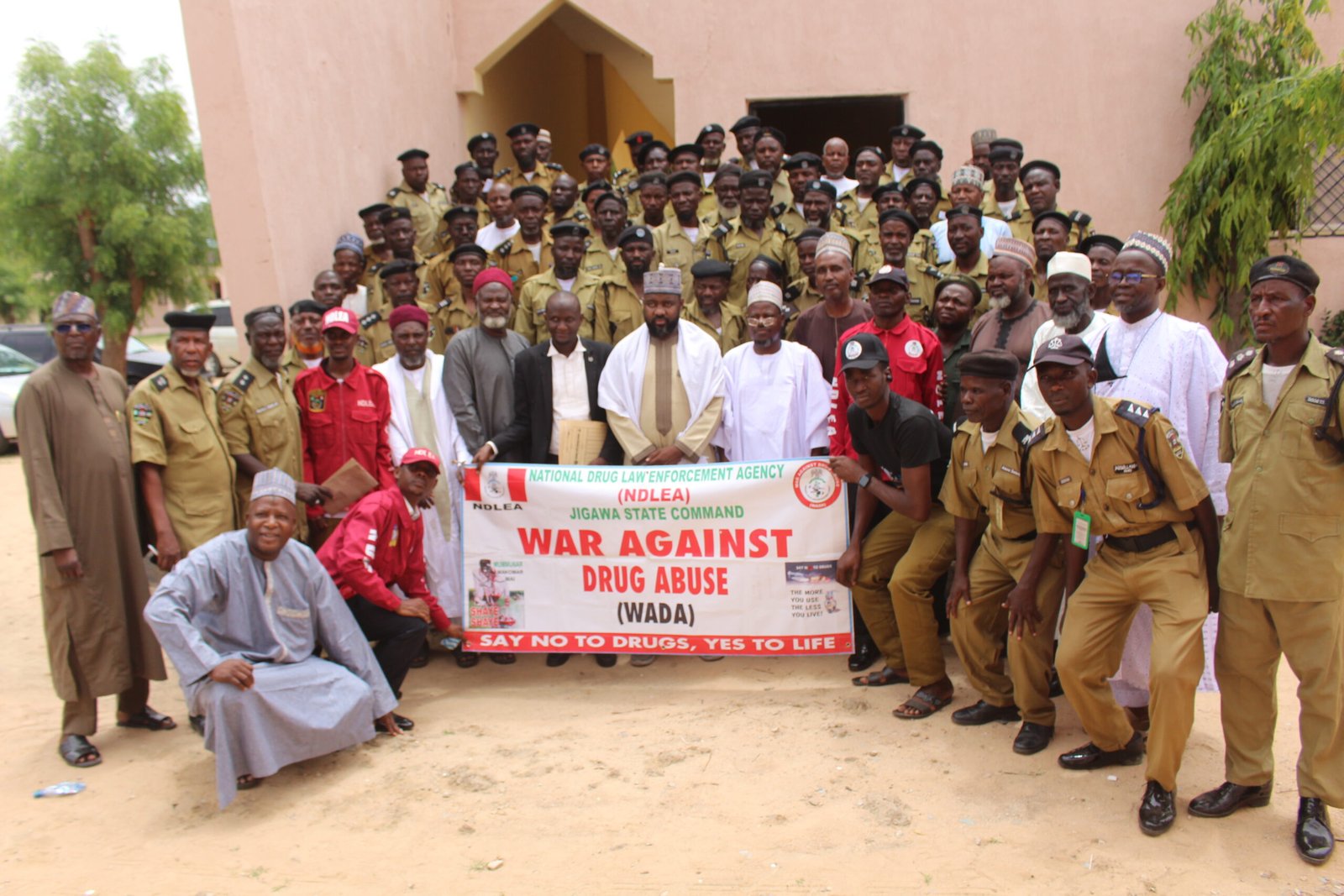
The Commandant of the Jigawa State Hisbah Board, Dr Muhammad Fa’iz Bashir Haruna, disclosed this on Wednesday, July 8, 2026, during a sensitisation workshop organised by the board in collaboration with the NDLEA at the Jigawa State Library in Dutse.
Haruna said the workshop was designed to equip Hisbah personnel with practical knowledge of different types of abused drugs and substances, their dangers and the devastating consequences of addiction on individuals, families and communities.
He said the collaboration became necessary because Hisbah personnel operate at the grassroots and require adequate knowledge to identify emerging patterns of substance abuse and support lawful efforts by relevant authorities to tackle the menace.
“The collaboration is to draw the attention of Hisbah personnel to know the types and dangers of different drugs being abused across the nooks and crannies of the state,” Haruna said.
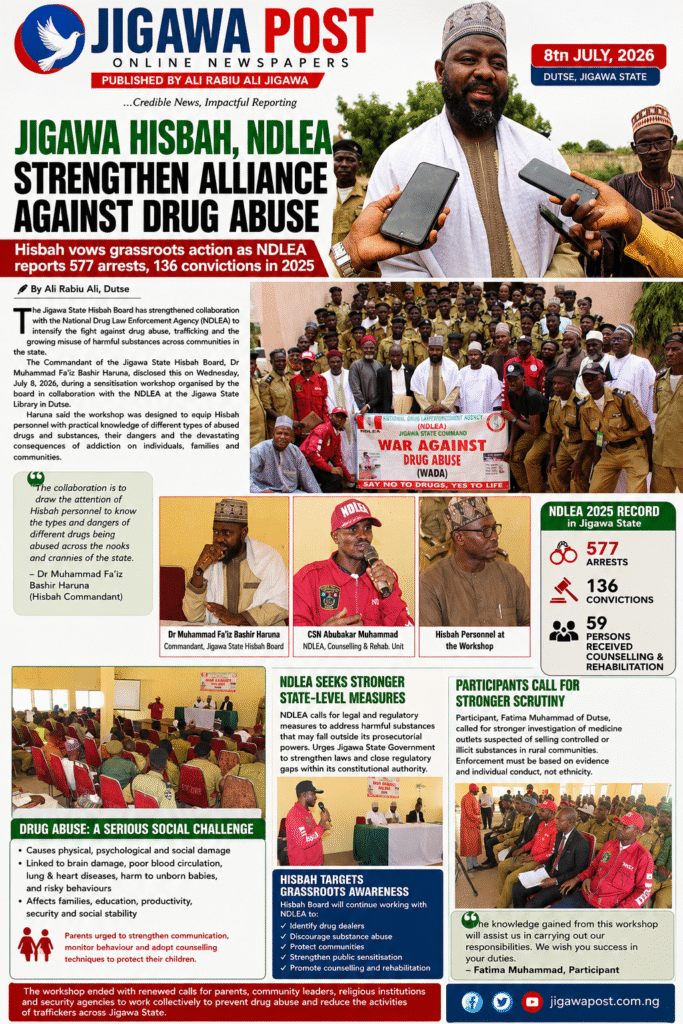
According to him, drug abuse has become a serious social challenge that requires sustained cooperation among Hisbah, the NDLEA, communities, parents, religious leaders and other relevant stakeholders.
The commandant said the Hisbah Board would work hand in hand with the NDLEA to support efforts aimed at identifying drug dealers, discouraging substance abuse and protecting communities from the harmful consequences of illicit drugs.
He said the NDLEA had used the workshop to expose Hisbah personnel to critical issues surrounding drug abuse, including classifications of substances, patterns of misuse and the health and social consequences associated with addiction.
Haruna added that the Jigawa State Government had provided equipment and operational vehicles to support the activities of the Hisbah Board, describing the intervention as important to strengthening the board’s grassroots operations.
He maintained that closer inter-agency cooperation would improve public sensitisation, intelligence sharing and community-level responses to the drug menace.
NDLEA Reports 577 Arrests, 136 Convictions
Speaking at the workshop, Chief Superintendent of Narcotics Abubakar Muhammad of the NDLEA Jigawa State Command disclosed that the agency arrested 577 suspected drug offenders and secured 136 convictions in the state in 2025.
Muhammad, who works with the Counselling, Treatment and Rehabilitation Unit of the command, said 59 persons also received counselling and rehabilitation interventions during the period.
He represented the Assistant State Commander in charge of Counselling, Treatment and Rehabilitation at the workshop.
The NDLEA officer said the programme focused on the effects and consequences of drug abuse and was intended to deepen the understanding of Hisbah personnel who work closely with communities.
According to him, his presentation covered the background and mandate of the NDLEA, classifications and types of abused drugs, as well as the physical, psychological and social consequences of substance abuse.
Muhammad warned that drug abuse had spread deeply into communities and should no longer be treated as a problem affecting only major towns or particular categories of people.
“The issue of drug abuse is beyond everyone’s expectation. It is almost everywhere you go. Hardly will you find a community without activities related to drug abuse,” he said.
He explained that Jigawa’s situation should be assessed within its own population and social context, noting that direct comparison with more populous neighbouring states such as Kano may not fully reflect the scale of the challenge.
Muhammad said the agency’s record of 577 arrests and 136 convictions in 2025 demonstrated the seriousness of the problem, while the counselling of 59 persons showed the importance of combining enforcement with treatment and rehabilitation.
Drug Abuse Damaging Families, Communities
The NDLEA officer warned that substance abuse could cause severe physical, psychological and social damage.
He identified possible consequences to include brain damage, poor blood circulation, lung and heart diseases, harm to unborn babies and exposure to risky behaviours that could result in serious health complications.
He said the consequences also extend beyond individual users, affecting families, education, productivity, security and social stability.
Muhammad therefore urged parents and guardians to strengthen communication with their children and adopt appropriate counselling and coping techniques to prevent young people from falling into drug abuse.
“My call to parents in Jigawa State is that they should try to adopt coping skills and other counselling techniques to prevent their children from drug abuse,” he said.
He stressed that parents must pay closer attention to changes in behaviour, peer groups and other warning signs that could indicate involvement in substance abuse.
NDLEA Seeks Stronger State-Level Measures
Muhammad also called for stronger legal and regulatory measures to address the misuse of harmful substances that may not fall directly within the NDLEA’s prosecutorial powers under existing drug-control laws.
He explained that some substances could be dangerous when deliberately abused even where the NDLEA lacks direct jurisdiction to prosecute users under narcotics legislation.
The officer urged the Jigawa State Government and relevant institutions to examine appropriate and lawful state-level measures that could close regulatory gaps and strengthen prevention.
He suggested closer cooperation among the state government, Hisbah, NDLEA, health authorities and other relevant institutions in responding to emerging patterns of substance misuse.
According to him, where legally appropriate, the state could consider measures within its constitutional authority to regulate harmful practices and empower relevant institutions to respond effectively.
Participant Calls for Closer Scrutiny of Medicine Outlets
A participant, Fatima Muhammad of Dutse, described the workshop as highly educative and called for stronger investigation of medicine outlets suspected of selling controlled or illicit substances in rural communities.
She expressed concern that some medicine sellers in villages could be contributing to the availability of abused substances and urged the NDLEA and other relevant authorities to intensify surveillance.
During her intervention, she referred to sellers from a particular ethnic group. However, the allegation was not independently verified and no evidence was presented at the workshop to establish wrongdoing on the basis of ethnicity.
Enforcement against illicit drug sales should be based on evidence, licensing status and individual conduct rather than ethnic identity.
Fatima said the knowledge gained from the workshop would assist participants in carrying out their responsibilities and wished them success in their duties.
Hisbah Targets Grassroots Awareness
The workshop underscored the growing role of the Jigawa State Hisbah Board in community sensitisation and grassroots mobilisation against social problems, particularly substance abuse.
With Hisbah personnel operating across communities in the state, officials believe better knowledge of abused substances and their effects could strengthen early identification, public education and lawful referral of suspected cases to relevant agencies.
Haruna maintained that the board’s partnership with the NDLEA would continue as part of broader efforts to protect young people and communities from the consequences of drug abuse.
He said the fight against illicit drugs requires more than arrests, stressing the importance of sustained enlightenment, family involvement, counselling, rehabilitation and inter-agency cooperation.
The workshop ended with renewed calls for parents, community leaders, religious institutions and security agencies to work collectively to prevent drug abuse and reduce the activities of traffickers across Jigawa State.



[…] Jigawa Hisbah, NDLEA Strengthen Alliance Against Drug Abuse […]